Teeth grinding
Effects on the temporomandibular joint and descending muscle chain
an article by Dr. med. univ. Christine Rudolf
Many people may be familiar with teeth grinding because, on the one hand, they cannot sleep due to the partner’s nocturnal “tooth scraping noises,” and on the other hand, they themselves repeatedly wake up in the morning with tense neck and shoulder muscles.
Others, in turn, notice that they also clench their teeth tightly together during the day when tense and concentrating (according to the well-known motto: “Bite your teeth together” – in stressful situations).
These grinding and pressing actions are also called bruxism or parafunctions of the masticatory organ.
These malfunctions primarily take place unconsciously at night and serve to reduce stress with more or less pronounced negative effects.
The symptoms that indicate bruxism are the following:
- We find diffuse pain in the area of the temples, the teeth, in the temporomandibular joint up to trigeminal neuralgia and tinnitus.
- There are clicking and rubbing noises in the temporomandibular joint when the mouth is opened wide. This indicates a tense masticatory muscle, which pulls the cartilage disc in the temporomandibular joint out of its position, causing it to loudly slip over the joint head.
- Another symptom we find is morning tension in the masticatory muscles, neck, shoulder girdle, and even back and lower back pain.
- Damage to the tooth substance in the form of grinding facets, flattened tooth cusps (especially visible on the canines of the upper jaw) is also an effect of grinding.
The triggering or risk factors for bruxism include, above all, the stress already mentioned above, either in permanent form or in times of peak stress (professional, private, psychological, …).
Tooth misalignments with incorrect contacts also provoke teeth grinding. An increase in the bite position by 0.1mm causes a measurably higher masticatory muscle tone after just 2 weeks. This also occurs when a tooth filling or crown is too high and the teeth constantly “rumble” over this obstacle when chewing.
Now to the effects of grinding and pressing:
- Due to the shortened masticatory muscles, the above-mentioned cartilage disc (discus articularis), which lies between the temporomandibular joint head and socket, is displaced and gradually worn out. Temporomandibular joint damage is the result.
- The tension in the masticatory muscles continues over the neck, shoulder, and back muscles and forms a descending chain of lesions. This can lead to blockages of individual vertebral bodies, a misalignment of the sacroiliac joint with pelvic obliquity and a measurable difference in leg length.
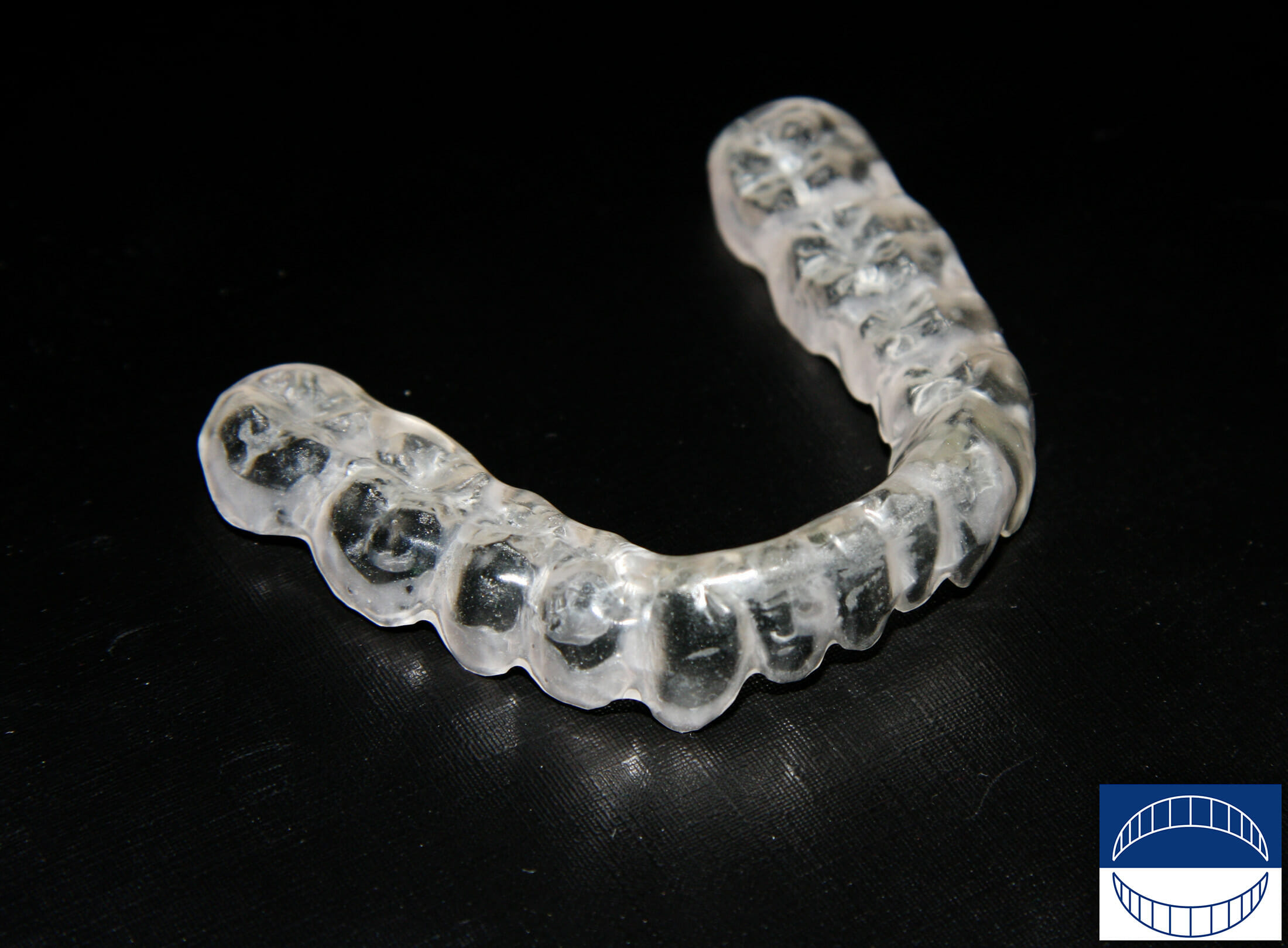
As therapy, we now use the so-called “night guard”, better called temporomandibular joint relief splint. This consists of solid plastic, is about 2mm thick and rests on the lower row of teeth. The patients bite or grind with reduced force as if on a “shock absorber.”
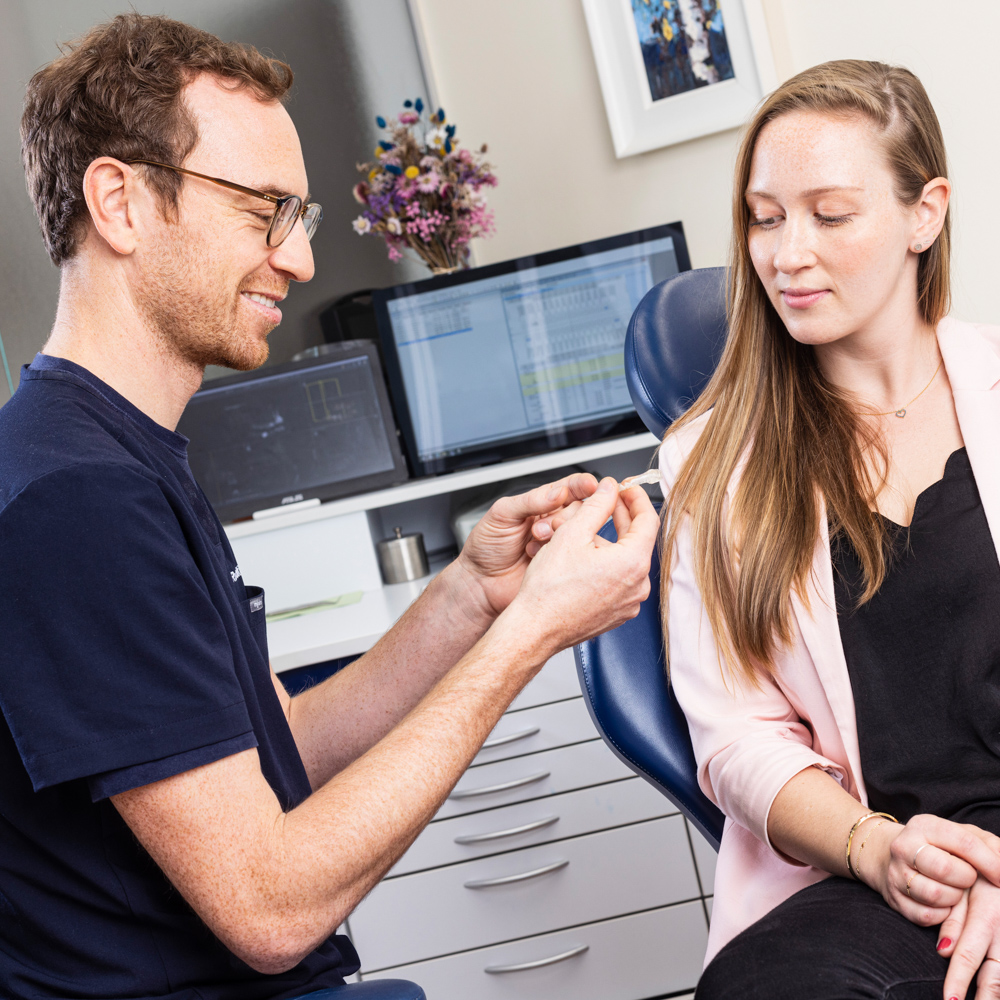
It seems sensible to me to send the patients to an osteopath before a splint is fitted, especially if there are existing spinal problems. Then impressions of the upper and lower jaw are taken and a bite registration is made of silicone. The technician then manufactures the splint. I check the optimal splint position during the transfer using a leg length test, posture control and muscle test (this is a kinesiological diagnostic and therapeutic method that I also use for many other dental problems).
As accompanying measures to wearing the splint, I recommend massages, further osteopathic treatments, and possibly autogenic training or biofeedback to reduce stress.
In the case of high stress levels or severe temporomandibular joint problems, the splint should initially be worn all day for 1-2 weeks, then only at night.
After 2-3 weeks, the splint is checked and possibly ground in, as the tooth contacts change due to the more relaxed muscles. Later, the splint is only checked every 2-3 months.
In the case of extreme tooth misalignments, orthodontic treatment can be considered in parallel with splint therapy.
Sometimes it also makes sense to produce technical work, such as crowns, bridges, implants etc. following splint therapy.
For pure “stress grinders,” the night guard will probably remain a lifelong nocturnal companion!