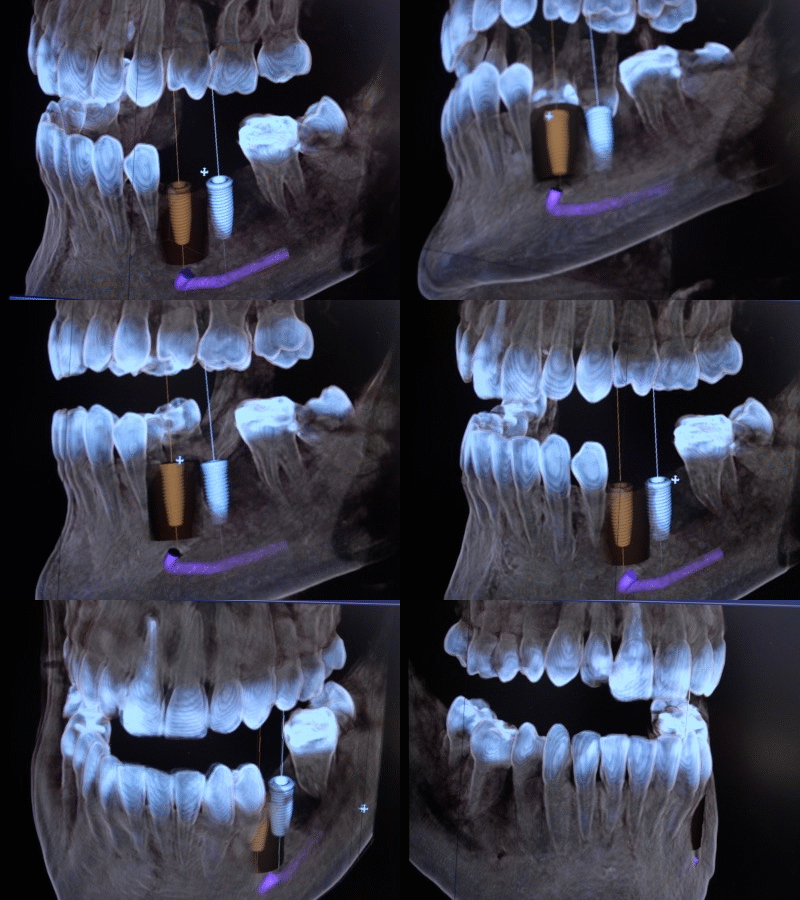
Dental implants
Thanks to modern technology and precise planning, we make it possible for you:
– to remove diseased teeth in just one session and replace them with implants (immediate implants)
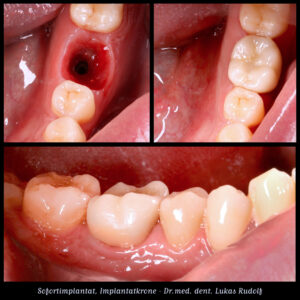
– and, thanks to our scanning/milling technology, in many cases also to immediately provide a temporary crown (immediate loading). After a healing period of 3-6 months, this is replaced by a definitive ceramic crown.
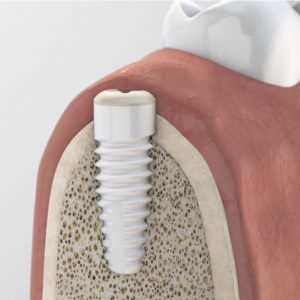
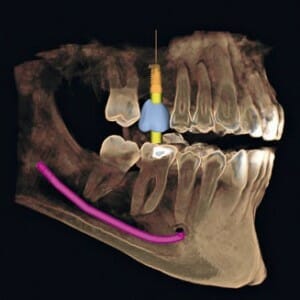
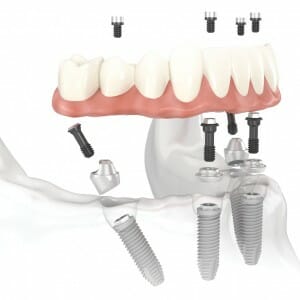
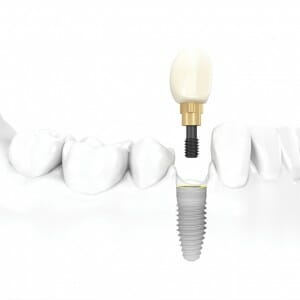
An implant is an artificial tooth root made of titanium or ceramic that grows firmly into the jawbone and enables permanent dentures. Even with complete tooth loss, a fixed or removable denture is possible. An implant has considerable advantages over a bridge.
Dental implants, as placed in our practice in Vienna, are made of pure titanium or, if a completely metal-free replacement is desired, zirconium dioxide ceramic. Many years of scientific experience and special surface coatings enable rapid healing in the jawbone for both titanium and ceramic. We decide which variant makes more sense with you on a case-by-case basis during an initial consultation.
The success rate of dental implants in the literature is approximately 95% over 10 years. Our recommendation is to pay attention to perfect oral hygiene at home. This way, implants can replace teeth for a lifetime.
Advantages of dental implants:
– Fixed restoration possible.
– No grinding and no increased stress on the adjacent teeth (bridges)
– The continuous degradation of the jawbone is stopped.
– Fixed restoration possible in case of complete toothlessness
For a consultation appointment regarding a dental implant, please contact us by email at implantate@dr-rudolf.at or by phone at 01/2142127.
Special feature in our practice: Copy of the old tooth “Biocopy”
Thanks to a digital impression before tooth extraction and our own ceramic laboratory with milling machine, we can “copy” the aesthetics of the old tooth and provide the tooth gap with a temporary crown on the implantation date. This is placed on the implant approximately 1 hour after the operation. This is designed to be slightly lower so that the implant is not excessively stressed during the healing period.
After a healing period of the implant of 3-6 months, a definitive ceramic crown is finally placed on the implant, where aesthetics and bite are as usual again.
Ceramic Implants
The frequently expressed desire for a metal-free restoration has been fulfilled by the development of zirconium implants. We use an innovative two-piece implant system, which means that the “screw” anchored in the bone can be separated from the crown should a repair or an extension by further teeth be necessary, e.g. for an implant-supported bridge. This used to be reserved for conventional titanium implants only. This makes the system “future-proof.”
You can also find more information under this article.
Advantages of ceramic implants
- improved aesthetics of the soft tissue (gums), especially with delicate/thin gums, due to the white color of the implant
- metal-free restoration
- demonstrably good bone healing
- possibly lower risk of inflammation at the edge of the implant (peri-implantitis)
F :Titan- oder Keramikimplantate?
A :Jahrzehntelange Erfahrung mit Titanimplantaten stehen einer metallfreien Versorgungsmöglichkeit mit Keramikimplantaten gegenüber. Sollten Sie an einer Titanunverträglichkeit leiden (die in einem Labor mittels Bluttest eruiert werden kann), ist ein Keramikimplantat eine optimale Lösung, ansonsten haben sich Titanimplantate durch eine weniger spröde Materialkonsistenz gut bewährt. Gerne bespreche ich mit Ihnen, welche Variante für Sie optimal ist.
F :Wieviele Termine sind für ein Zahnimplantat notwendig?
A :In Summe sind meist 6 Termine notwendig. 1. Termin: Befundaufnahme und eventuell 3D-Röntgenaufnahme, 2. Termin: Besprechung, Planung und Aufklärungsgespräch, 3. Termin: Implantation / Operation, 4. Termin: Nachkontrolle und Nahtentfernung. Anschließend erfolgt die Einheilung, die zwischen 2-6 Monaten dauert. 5. Termin: Abformung für den Zahntechniker, 6. Termin: Einsetzen der Krone. Anschließend sind regelmäßige Nachkontrollen sinnvoll.
F :Prothese, Brücke oder Implantat?
A :Eine Prothese ist die einfachste, günstigste, jedoch herausnehmbare Lösung.
Mit Brücken können Lücken festsitzend geschlossen werden. Die Nachbarzähne müssen beschliffen werden, die kann in gewissen Fällen jedoch von Vorteil sein.
Implantate sind Prothesen oder Brücken in den meisten Fällen überlegen, da der kontinuierliche Abbau des Kieferknochens aufgehalten wird. Es müssen auch keine (gesunden) Nachbarzähne beschliffen werden.
F :Mit welchen Kosten muss ich rechnen?
A :Obwohl es sich um eine Privatleistung handelt, übernehmen manche Krankenkassen einen Teil der Implantatationskosten. Private Zusatzversicherungen übernehmen meist 80% der Kosten.
Woraus setzen sich die Kosten zusammen?
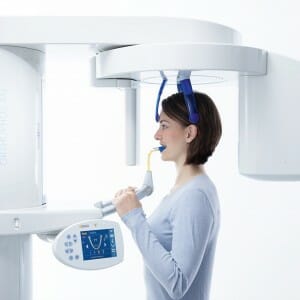
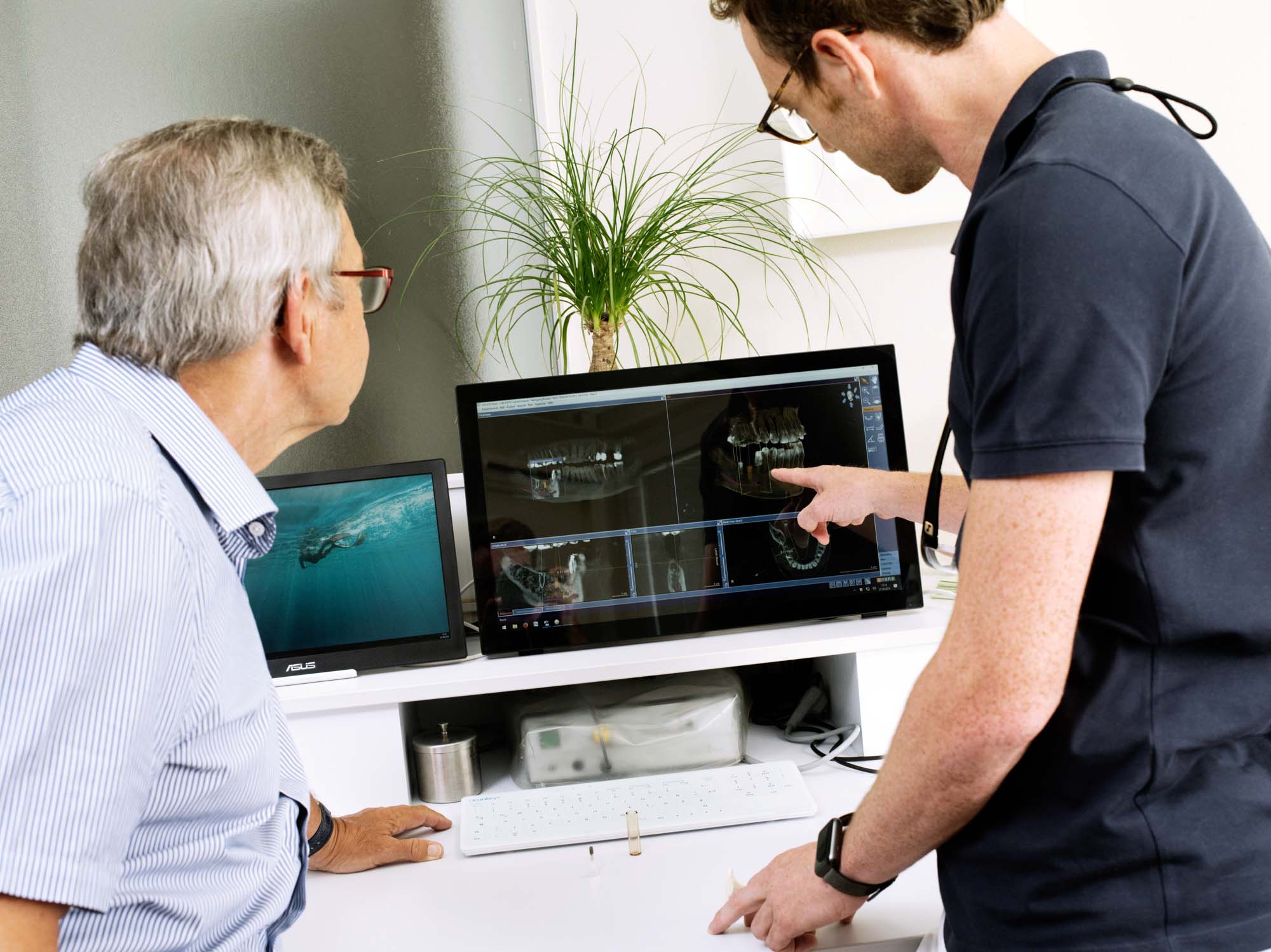
- Diagnostik und Planung (Volumentomograph / 3D-Röntgen)
- Operationskosten (erhöhter steriler Aufwand)
- Materialaufwand (hochwertigste Implantatkomponenten)
- Laborkosten / Zahntechnik (Keramikkrone mit Titan oder Zirkonkeramik-Zwischenstück)
- Nachsorge
Um Ihnen eine sichere Behandlung am aktuellen Stand der Wissenschaft zu ermöglichen, setzen wir ausschließlich Titanimplantate etablierter Hersteller.
Ästhetisch-funktionelle Aspekte spielen in der Zahnmedizin eine große Rolle, daher verlassen wir uns bei der Erstellung der Implantatkrone auf ausgezeichnete, lokale Zahnlabors.
Nach einer Befundaufnahme (Kontrolle) können wir Ihnen eine seriöse Auskunft über die zu erwartenden Operations- und Behandlungskosten geben.
F :Wie hoch ist das Risiko, ein Implantat zu verlieren?
A :Bei gesundem Allgemeinzustand ist das Risiko sehr gering, ein Implantat zu verlieren.
Gewisse Risikofaktoren erhöhen das Risiko für einen Implantatverlust:
- Raucher (stark erhöhtes Risiko, korreliert mit der Anzahl der Zigaretten / Tag)
- Patienten mit Osteoporose oder Diabetes (stark erhöhtes Risiko bei schlecht eingestelltem HbA1c)
- Frauen in hohem Alter
- Patienten mit unbehandelter Parodontitis
(vgl. Dr. med. dent. Lukas Rudolf: Radiologischer peri-implantärer Knochenabbau: eine retrospektive Studie, 2015, Implantatakademie, Wien)
Damit Zahnimplantate langfristig funktionieren, ist eine optimale Mundhygiene notwendig. Auch die Sanierung von bestehenden Zähnen ist eine wichtige Voraussetzung. Wir beraten Sie dazu gerne.
F :Wie pflege und sorge ich um mein Implantat?
A :- Optimale Mundhygiene und Zahnputztechnik
- Reinigung der Zahn- und Implantatzwischenräume
- Regelmäßige Kontrollen mit Röntgenbildern
- Regelmäßige Mundhygiene-Sitzungen (professionelle Zahnreinigung)
- Aufbewahrung Ihres Implantat-Passes, bei Wohnort & Zahnarzt-Wechsel ist dieser für Nachbehandler wichtig!
Beherzigen Sie diese Punkte, können Sie ein Leben lang Freude mit Ihren Implantaten haben!